
Why The Resort Name On Your Membership May Not Be The Company You’re Legally Bound To When You Purchased Your Vacation Club Membership In Mexico…
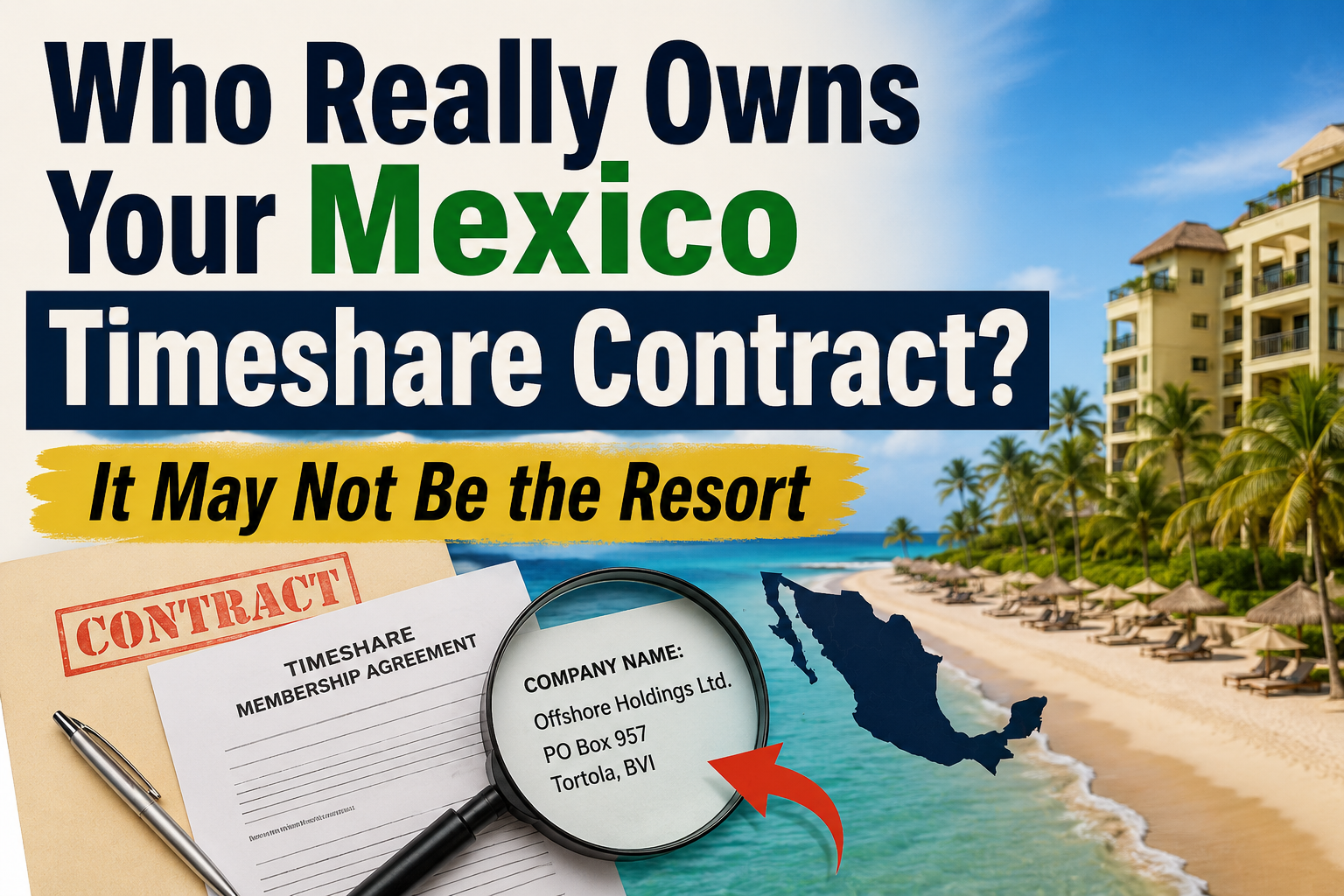
In my last article, I walked owners through Concord Finance and the “Transfer Agent” pattern I’ve seen attached to vacation club promissory notes. That article touched on a bigger structural issue, and this one is about that issue directly: the resort brand you recognize — the one on the sign, the one you booked your original stay through — is very often not the company that actually signed you up, priced your membership, or has the legal right to enforce your contract. That’s typically a separate corporation, frequently incorporated somewhere with no real connection to you, the resort, or where you signed. In my book and in my videos, I call this the brand-versus-entity split, and after 15 years inside this industry, I can tell you it is one of the most consistent patterns in vacation ownership sales.
The Pattern
It generally works like this. A well-known hospitality brand — a hotel chain, a resort group, an all-inclusive collection — lends its name, its marketing, and its properties to a “vacation club” or “membership” program. But the entity that actually signs the membership contract, collects your payments, and can sue or be sued over the agreement is a separate company, often incorporated in a jurisdiction chosen for its own convenience rather than yours — not the country where you live, not the country where the resort sits, and sometimes not even the country where you signed. Buried in the contract is a clause requiring you to bring any dispute only in that chosen jurisdiction, and in many cases requiring you to expressly waive the right to sue anywhere else, including your own home courts.
None of that is automatically illegal. Businesses are allowed to incorporate where they choose and to negotiate a governing-law clause. What I’ve found troubling, across years of reviewing these contracts, is how often the disclosed entity turns out not to be properly licensed to do business in the country where it was actively out selling memberships — and how rarely the average buyer is told, in plain language at the point of sale, exactly which company they are legally contracting with.
A Documented Example: UVC Global Panama and UVC Sales Panama
I recently reviewed a membership contract for “Unlimited Vacation Club by AMResorts” — a real, well-established hotel management company that operates Secrets, Dreams, Breathless, and Zoëtry resorts across Mexico, the Caribbean, and Central America. I want to be clear about something up front: AMResorts itself is a legitimate, large operator, and nothing here is a claim that the hotel company is doing anything improper. The issue is what’s actually named as the contracting party in the membership paperwork.
The contract identifies the party the member is actually agreeing with — called the “Mediator” — as two separate companies: UVC Global Panama, S. de R.L. and UVC Sales Panama, S. de R.L., represented by a named individual, with a notice address in Panama. The contract’s own Recital I states these companies are “duly constituted and in good standing under the laws of Republic of Panama.” Clause SEVENTEENTH then makes Panama the exclusive governing law and forum for any dispute, with the member “waiv[ing] any other jurisdiction to which they may be entitled by reason of their present or future domicile or location of their property, or for any reason” — while separately carving out that any financing promissory note connected to the purchase is governed by its own, separate terms.
Multiple Jurisdication Contradictions
That last point matters, because it’s the same layering I described with Concord Finance: the membership contract names one governing jurisdiction, and any note used to finance the purchase can quietly name a different one. Two documents from the same sale, two different legal systems chosen to resolve a dispute — and the buyer signs both.
The paperwork also names two additional entities worth knowing about:
- International Cruise & Excursion Gallery, Inc. (“ICE”), a Delaware corporation based in Scottsdale, Arizona, which administers a bundled loyalty add-on. Its own enrollment form explicitly disclaims that it warrants compliance with the laws of the jurisdictions where it operates.
- GBS International, Inc., which appears as an alternate billing entity on the payment authorization pages.
So a single membership sale, sold under one recognizable resort brand, can involve at least four separate corporate names across three jurisdictions — Panama, Delaware, and wherever the billing entity is actually organized — none of which is the resort brand itself.

A Former Insider’s Perspective
I spent 15 years working as a sales and marketing director in this industry, across the United States, Canada, Mexico, and the Caribbean, before I walked away from it — largely because of what I saw happening with exactly this structure. In my experience, the membership is typically sold and administered through a separate “vacation club” or “mediator” company that licenses the resort’s name and image but is a distinct corporation, often incorporated offshore from where the sale actually happens. In many cases I encountered across Mexico and the Caribbean, that separate vacation club entity was not properly licensed to conduct business in the country where it was actively selling memberships to consumers.
I want to be precise about what I am and am not saying. This is my professional assessment, based on years inside the industry, not a specific finding about the current legal or licensing status of UVC Global Panama, UVC Sales Panama, or any other individual company named in this article. Verifying a company’s actual licensing status in a given country takes a records check I haven’t performed for every name that crosses my desk. What I can tell you with confidence is that the structure itself — brand in one place, contracting entity in another, financing note in a third — is common, and it is worth every owner’s time to ask exactly who they signed with.
Why the Jurisdiction Clause Matters
A waiver isn’t automatically enforceable.
A clause requiring you to waive your home jurisdiction and litigate only in Panama, Curaçao, or wherever the contracting entity is based is a serious provision — but whether it actually holds up if challenged is a legal question specific to the facts, including where you signed, what disclosures you received, and what consumer-protection law applies where the sale took place. Courts in a number of countries have declined to enforce foreign forum-selection clauses against consumers when they were buried in fine print or when local consumer-protection law says otherwise. That’s not something I can tell you the outcome of in advance — it’s something a locally qualified attorney needs to evaluate.
Local consumer-protection agencies may still have a role.
If your membership was sold in Mexico, PROFECO may still have jurisdiction to hear a complaint about the sale itself, regardless of what governing-law clause is buried in the contract. The same logic applies to consumer-protection agencies in other countries where these sales happen. A jurisdiction clause governs disputes between you and the company under the contract — it does not automatically override a government regulator’s authority to investigate how the sale was conducted.
The financing note is a separate fight.
If you signed a promissory note in addition to the membership contract, treat it as its own legal document with its own governing law, its own named counterparty, and its own risks — reviewing the membership contract alone is not enough.
What To Do If Your Contract Names an Offshore “Mediator” or Administrator
- Get the exact legal name of every company on your paperwork — not just the resort brand. Look for terms like “Mediator,” “Administrator,” “Transfer Agent,” or “Seller” and write down the full corporate name, not the marketing name.
- Ask, in writing, whether that specific company is licensed to do business in the country where you signed. A legitimate company should be able to answer this without difficulty.
- Request a complete, signed copy of every document you executed, including any promissory note, and read the governing-law and jurisdiction clauses in each one separately.
- Don’t assume a jurisdiction clause is the last word. It may or may not be enforceable depending on where you signed and what protections apply there — that determination needs a locally qualified attorney, not a guess.
- If the sale happened in Mexico, consider filing a complaint with PROFECO in addition to any dispute with the company directly.
- Get any new document — especially a promissory note or a “trade-in”/exit agreement — reviewed before you sign it, not after.
Bottom Line
The resort name on your welcome folder is rarely the whole story. Behind most vacation club memberships sits a separate contracting entity, often incorporated somewhere chosen for the company’s convenience rather than yours, and sometimes a third entity again for financing. None of that is proof of wrongdoing by itself — but it is a structure that makes it much harder for an average buyer to know exactly who they’re bound to and where they’d have to go to enforce their rights. Get the actual legal names, ask about licensing, and don’t sign anything new without review.
This article reflects a document I personally reviewed (identifying details redacted for privacy) combined with patterns I’ve documented over years of helping timeshare and vacation club owners. It is provided for general consumer education, is not legal advice, and Everything About Timeshares is a document preparation service, not a law firm. If your paperwork names an unfamiliar “Mediator,” administrator, or transfer agent, I’m happy to take a look and talk through your options.
— Wayne C. Robinson, Everything About Timeshares