
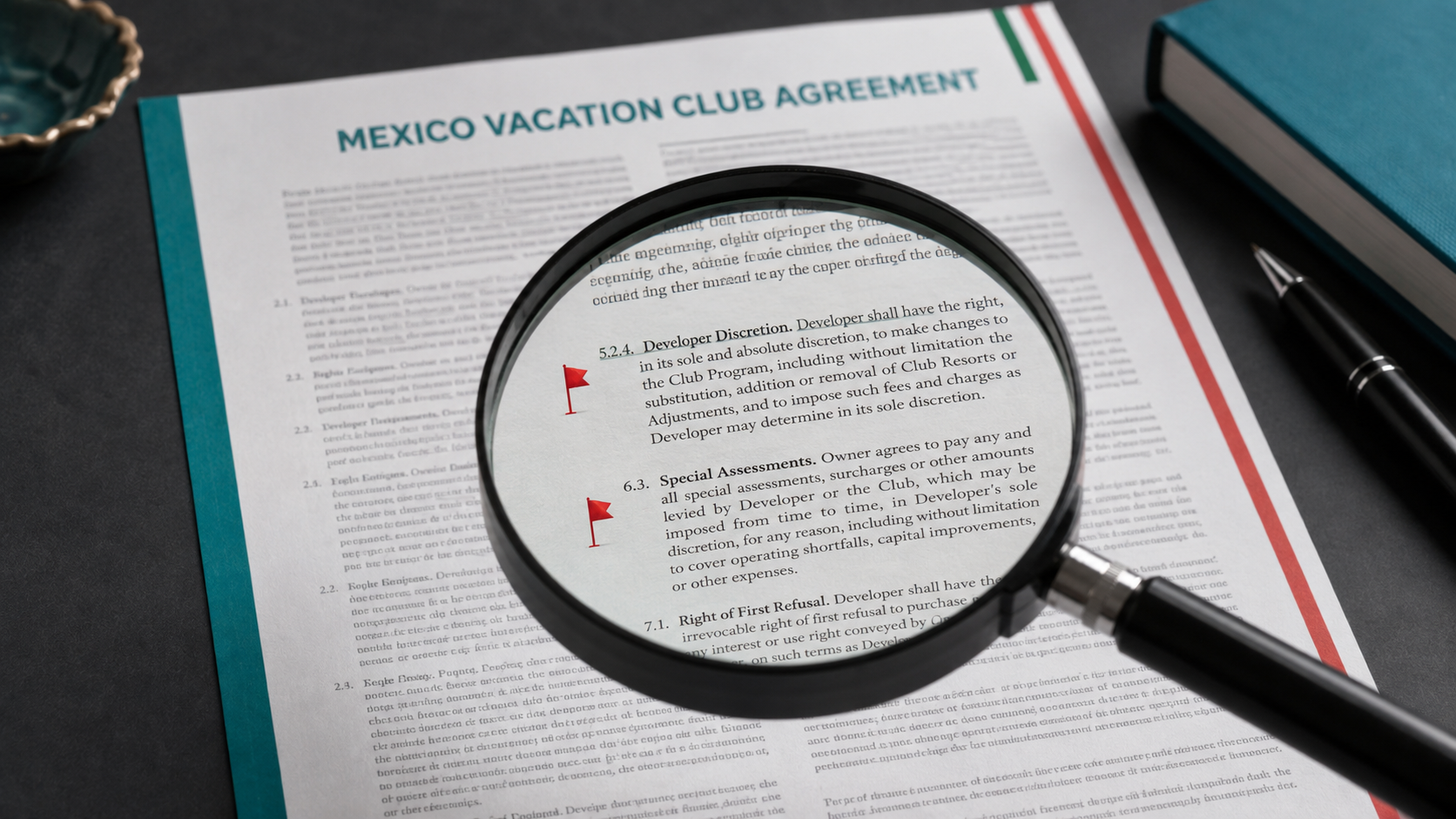
You’ve decided you want out of your Mexico timeshare. You search online for help and suddenly find dozens of companies promising to cancel your ownership, eliminate your maintenance fees, negotiate with your resort, or make the entire problem disappear.
Then you see the prices.
$3,000. $5,000. $8,000. Sometimes $10,000 or more.
Now you have another problem: How do you know whether you’re dealing with a legitimate Mexico cancellation company or a Mexico timeshare exit scam?
That’s an important question because both legitimate businesses and scammers can have professional websites, impressive testimonials, knowledgeable salespeople, contracts, and convincing explanations of what they claim they can do for you. The difference isn’t always obvious from looking at a website or talking to a salesperson for 20 minutes.
I spent approximately 15 years working inside the timeshare industry in sales, marketing, contracts, and management in the United States, Canada, Mexico, and the Caribbean. Today, I help owners understand their cancellation options. Based on that experience, here are seven things I believe every timeshare owner should examine before paying anyone to help cancel a timeshare.
1. They Should Understand Your Mexico timeshare Before Telling You They Can Cancel It
This is one of the first things I would look for.
Not every timeshare is the same. An owner with a paid-in-full deeded timeshare in Florida is in a different situation from someone who owes $25,000 on a vacation club membership in Mexico. A points-based ownership can present different issues from a traditional fixed-week ownership.
Before recommending a solution, a legitimate cancellation company should want to know what you actually own. At a minimum, I would expect questions about the resort, whether the ownership is paid in full, whether there is an outstanding loan, whether maintenance fees are current, what type of ownership you have, and where the timeshare is located.
When someone tells you, “Yes, we can definitely cancel it,” before learning anything meaningful about your ownership, I would become cautious. How can someone recommend the correct solution before understanding the problem?
This is also why I believe an owner should have the situation reviewed before purchasing a cancellation service. The first conversation should be about your Mexico timeshare—not about your credit card.

Thinking About Cancelling Your Mexico timeshare?
✓ 100% Free
✓ no high pressure sales tactics
2. Be Careful With Guarantees—Especially When Nobody Explains the Process
The Federal Trade Commission specifically warns consumers about Mexico timeshare exit companies that advertise guaranteed results. That doesn’t mean a legitimate business can never stand behind its work or offer a written refund policy. There’s an important difference between standing behind a clearly defined service and making an extraordinary promise without explaining how that promise will be accomplished.
If someone says, “We guarantee your Mexico timeshare will be gone in 60 days,” my next question would be: How?
What exactly will the company do? Will it contact the resort? Prepare documents? Negotiate? Pursue a deed-back? Arrange a transfer? Provide legal representation? Is an attorney involved? What happens if the resort refuses?
A legitimate company should be able to explain the service you’re buying in understandable language. You shouldn’t have to accept, “Don’t worry about it. We know what we’re doing.”
I’ve spent years working with Mexico timeshare contracts. One lesson that experience taught me is that the details matter. If someone cannot explain the process before taking your money, I would think very carefully before proceeding.
3. An Upfront Fee Requires More Investigation—But It Doesn’t Automatically Mean Fraud
This is where consumers need to understand an important distinction.
The FTC and FBI warn about scams in which people unexpectedly contact Mexico timeshare owners, promise sales or exits, and demand money upfront. This is particularly dangerous when someone claims a buyer is waiting but says you must first pay taxes, closing costs, transfer charges, or some other fee before receiving your money.
But that doesn’t mean every business that requires payment before performing professional work is fraudulent. Attorneys commonly require retainers. Accountants charge deposits. Consultants charge fees. Document-preparation companies charge for preparing documents. Professional services aren’t automatically free until the desired outcome occurs.
The real question isn’t simply “Are they charging me upfront?” The better question is “What exactly am I paying for?”
If you’re paying $5,000, you should know what work will be performed, when it will begin, what documents or services you will receive, what the company’s responsibilities are, and what happens if the promised service isn’t delivered.
There is also a major difference between paying a professional for clearly identified work and wiring $4,000 to a stranger who called you unexpectedly and claims a buyer is waiting for your Mexico timeshare. Don’t confuse the two.
4. High-Pressure Sales Tactics Should Make You Slow Down
Mexico timeshare owners should already be familiar with high-pressure sales tactics. Many people originally purchased their Mexico timeshares during presentations where they were told the special price, bonus points, upgraded unit, or other incentive was available today only.
You shouldn’t have to go through another high-pressure sales presentation just to get out of the first one.
Be cautious if an exit salesperson tells you that you must sign immediately, the price increases tomorrow, your situation is about to become impossible to resolve, or some special cancellation opportunity will disappear if you don’t provide a credit card before hanging up.
Pressure is particularly effective on Mexico timeshare owners because many have already reached the point of frustration. They’re tired of maintenance fees, of trying to sell, and of calling the resort. They want the problem gone.
A salesperson knows that.
Don’t allow frustration to determine how quickly you make a several-thousand-dollar decision. If the company is legitimate today, it should still be legitimate tomorrow after you’ve read the agreement and investigated its claims.
5. Vague Explanations Are a Serious Warning Sign
Ask this question before signing anything:
“Exactly what are you going to do to cancel my Mexico timeshare?”
Then listen carefully.
You don’t necessarily need to understand every legal or administrative detail, but you should understand what you’re purchasing. If you’re paying thousands of dollars and the salesperson cannot explain the service in plain English, something is wrong.
Watch for vague phrases such as “We have a special process,” “We know people inside the resort,” “Our legal department handles everything,” or “You don’t need to worry about the details.”
I would worry about the details.
You should know whether you’re purchasing document preparation, attorney representation, negotiation, transfer services, resale assistance, or something else entirely. These services are not interchangeable simply because someone places the words “timeshare exit” on a website.
A legitimate business should be willing to tell you what it’s selling.
6. Look Carefully at How They Want You to Pay
Payment method deserves attention, particularly when you’re dealing with someone who contacted you unexpectedly.
The FBI has warned Mexico timeshare owners about fraud schemes involving requests for upfront payments and sophisticated attempts to convince victims that transactions are legitimate. Once money has been sent through certain payment methods, recovering it can become extremely difficult.
If someone you’ve never dealt with unexpectedly asks you to wire thousands of dollars, send cryptocurrency, purchase gift cards, or transfer money to an unfamiliar individual or overseas account, stop and investigate.
Also look at who is receiving your money. Does the name on the payment request match the company named in your agreement? Are you paying an established business or an individual you’ve never heard of? If a salesperson says you’re hiring ABC Timeshare Exit Company but your money is being sent somewhere completely different, ask why.
A legitimate business should be able to clearly explain how it accepts payment and identify the business receiving your money.
Thinking About Cancelling Your Mexico timeshare?
✓ 100% free
✓ no high pressure sales
7. The Written Contract Should Match What You Were Told
This may be the most important step of all.
The FTC advises consumers to get promises in writing and make sure the contract matches what they were told verbally. I strongly agree.
Salespeople talk. Contracts document.
If the salesperson tells you, “You’ll be completely out in 90 days,” but the contract doesn’t say that, which one do you think matters when there’s a disagreement?
If you’re promised a refund, read the refund provision. Is it unconditional, or are there requirements you must meet? How long does the company have to perform? What exactly constitutes successful completion of the service? What are your responsibilities?
Don’t allow a salesperson to rush you through the agreement while saying, “That’s just standard legal language.” Read it.
I worked with Mexico timeshare contracts during my years in the industry, and I can’t emphasize this enough: what someone tells you and what you sign are not necessarily the same thing.
If you don’t understand the agreement, don’t sign it until you do.
How I Would Investigate a Mexico timeshare Cancellation Company
Before paying anyone several thousand dollars, spend some time investigating the company independently. Search the company name along with terms such as “complaints,” “reviews,” “lawsuit,” and “scam.” Look beyond the company’s own website and advertising.
Verify that the business actually exists. Look for a real business address, telephone number, company registration where applicable, and identifiable people behind the company. If the company claims attorneys will represent you, find out who those attorneys are and verify their licenses independently.
You should also look at how long the company has been operating. A polished website created recently can look every bit as professional as one belonging to a company that has operated for years.
And don’t rely exclusively on online reviews. Reviews can be useful, but they should be one part of your investigation rather than the entire investigation.
A Legitimate Company Should Be Willing to Answer Difficult Questions
Before hiring a Mexico timeshare cancellation company, ask questions. Lots of them.
Ask what service is being provided, who will perform the work, how long the process normally takes, what happens if the resort refuses, what documentation you’ll receive, whether you should continue paying your maintenance fees and loan payments, what the refund policy is, and what happens if the company cannot complete the promised service.
Pay attention not only to the answers but also to how the company responds to being questioned. Someone asking you for $5,000 should not become irritated because you want to understand what you’re buying.
In my experience, informed consumers make better decisions. A legitimate professional should want the client to understand the service rather than depend on confusion to make the sale.
One More Warning: Be Careful If You’re Told to Stop Paying
The FTC specifically identifies instructions to stop paying your Mexico timeshare mortgage or fees as a warning sign associated with some Mexico timeshare exit operations.
This issue requires careful consideration because stopping payments can have consequences, particularly when there is an outstanding loan. Don’t stop making payments simply because a salesperson tells you, “Don’t worry about it—we’ll handle everything.”
Before taking an action that could affect your account, collections activity, or credit, understand the possible consequences and why that particular strategy is being recommended for your situation.
There is a difference between making an informed decision after understanding the consequences and blindly following instructions from someone whose primary goal may have been collecting your payment.
The Difference Comes Down to Transparency
There isn’t one magical test that separates every legitimate Mexico timeshare cancellation company from every scam. A professional website doesn’t prove legitimacy. A high price doesn’t prove fraud. An upfront payment doesn’t automatically prove fraud. Even positive reviews don’t guarantee that a company is right for your situation.
What you’re looking for is transparency.
Does the company understand your particular ownership before recommending a solution? Can it explain exactly what you’re purchasing? Are the promises reasonable? Does the written agreement match the sales presentation? Can you independently verify the company and the people behind it? Are you being given enough time to make an informed decision?
Those questions tell you much more than a polished website ever will.
Before You Pay $3,000, $5,000 or $10,000, Understand Your Options
This is the part I believe many Mexico timeshare owners get backward. They begin searching for a Mexico timeshare exit company before they understand what options they actually have.
Start with your ownership.
Find out exactly what you own, whether there’s an outstanding balance, what your resort offers, what your contract says, and what realistic cancellation options may exist. Once you understand your situation, you’re in a much better position to decide whether you need professional assistance and what type of assistance you’re actually willing to pay for.
The goal shouldn’t simply be to find someone who says “Yes, we can get you out.”
The goal should be to understand how they’re going to do it, what you’re paying for, and who you’re trusting with your money.
Thinking About Cancelling Your Mexico timeshare?
Before paying a Mexico timeshare exit company thousands of dollars, find out what options may be available based on your specific resort, ownership, outstanding balance, and circumstances.
Wayne C. Robinson is spent 15 years selling timeshares around the world. Now he spends his time helping owners cancel their timeshares without impacting their credit score. He offers a 100% money- back guarantee.
About Wayne C. Robinson
Wayne C. Robinson spent 5 years working inside Mexico’s timeshare industry as a salesperson and verification officer, personally reviewing hundreds of purchase contracts with new owners. He knows the fine print, the standard loopholes, and the industry practices most foreign attorneys never encounter.
Sources
PROFECO main site — https://www.gob.mx/profeco
- Concilianet — PROFECO’s free online conciliation platform, the one most relevant for foreign timeshare owners since it lets you file and negotiate a dispute without traveling to Mexico: https://concilianet.profeco.gob.mx/Concilianet/inicio.jsp
- Módulo de Atención de Denuncias Ciudadanas — the online citizen complaint/denuncia portal for reporting a company directly: https://denuncias.profeco.gob.mx/
- REPEP (Registro Público de Empresas Proveedoras) — lets you check whether a specific company/resort is registered and see its complaint history before someone signs anything — this one’s worth linking prominently in your “how to spot a legit company” article since it’s a concrete verification step readers can actually do themselves: https://repep.profeco.gob.mx/denunciaenlinea.jsp
One caveat worth understanding: PROFECO’s jurisdiction and Concilianet process apply to consumer disputes with Mexican-registered businesses, but it doesn’t always have direct authority over foreign-based “exit” or “cancellation” companies (which is often the other side of this scam problem) — worth being precise about that distinction so readers don’t assume PROFECO can help against a scammy exit company based in the US or elsewhere.
- Concilianet – Procuraduría Federal del Consumidor
- Módulo de Atención de Denuncias Ciudadanas
- Denuncia en Línea | REPEP
Federal Trade Commission — Timeshares, Vacation Clubs, and Related Scams
- The FTC provides consumer guidance specifically addressing timeshare exit and resale scams, including guarantees, advance fees, unsolicited contacts, contracts, and instructions to stop making payments.
- Federal Bureau of Investigation — Timeshare Fraud
- The FBI provides warnings and red flags concerning sophisticated timeshare fraud schemes, unsolicited contacts, upfront payments, and fraudulent legal or government representations.
Leave a Reply